Source Natural Kraft Honeycomb Paper Sleeve for Packaging
Find 30 natural kraft honeycomb paper sleeve options for gift packaging, transportation protection, and craft applications. Compare customizable sizes, eco-friendly materials, and shock-absorbing features from verified suppliers to secure the right cushioning solution for your needs; compare the available evidence and request quotations based on your requirements.
Key considerations
Products List










Comprehensive Sourcing Guide
Natural Kraft Honeycomb Paper Sleeve Sourcing Guide
Procurement teams evaluating natural kraft honeycomb paper sleeves must first distinguish between general cushioning solutions and specialized protective packaging designed for high-value transport. The observed market data indicates a strong focus on eco-friendly materials, with listings frequently citing 100% recycled kraft paper and wood pulp as the primary raw materials. Buyers should verify that the specific product listing explicitly confirms the honeycomb structure, which provides unique hexagonal compartments essential for shock absorption.
When analyzing product listings, it is critical to note that while many suppliers offer customization, the base material composition varies significantly between standard and specialized items. Some observed products feature a 70 GSM thickness, while others specify 80 GSM, directly impacting the tensile strength and flexibility required for specific cargo. Sourcing decisions should prioritize suppliers who clearly define whether the product is uncoated or treated, as this determines its suitability for moisture-prone environments or direct food-contact applications.
Product Scope and Observed Listing Signals
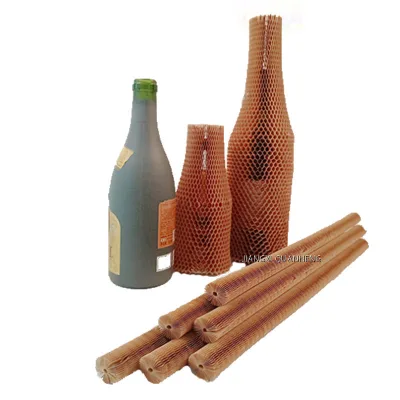
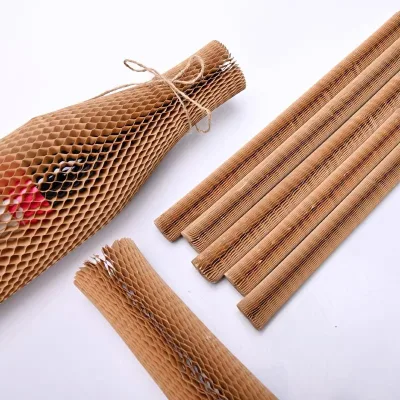
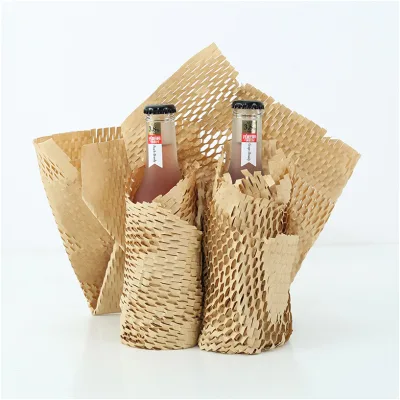
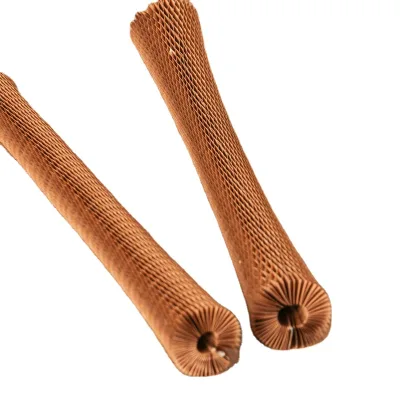
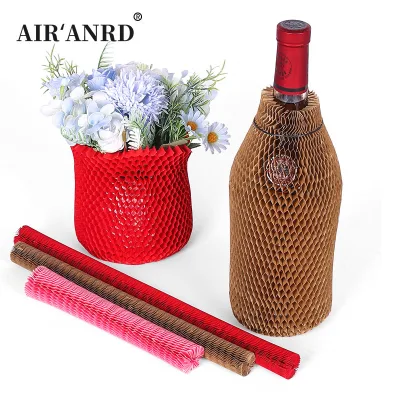
The core product scope encompasses cylindrical and round-shaped sleeves designed primarily for transportation protection and gift packaging applications. Market observations reveal that these items often serve as a direct replacement for bubble wrap or foam, offering a 60% faster application rate while maintaining excellent shock absorption capabilities. Buyers should look for listings that explicitly mention the "Honeycomb Cushioning Kraft Paper" designation to ensure the hexagonal structure is present, rather than standard corrugated board.
Listing signals also highlight the versatility of these sleeves in industrial uses ranging from composite plates to general carton reinforcement. The observed data suggests that while some products are sold as single items, others may be packaged in 5-ply corrugated cartons for bulk shipping. Procurement professionals must carefully review the "Usage" and "Application" fields in supplier catalogs to confirm alignment with specific needs, such as anti-curl properties or greaseproof requirements, which are not universal across all kraft paper sleeves.
Technical Specifications to Verify
Technical verification begins with confirming the precise paper weight and structural integrity of the honeycomb core. Buyers must cross-reference the listed GSM, which ranges from 70 to 80 in observed samples, against their specific load-bearing requirements to ensure the material offers sufficient tensile strength and flexibility. It is equally important to validate the thickness and length specifications, as observed listings provide fixed dimensions like 10mm by 900mm alongside customizable options that may alter the final performance characteristics.
Further technical due diligence requires checking the physical dimensions and single package size to optimize logistics planning. Observed data indicates a single package size of approximately 37x45x37 cm with a gross weight of 8.000 kg, which significantly impacts freight costs and warehouse storage calculations. Procurement teams should also verify the shape classification, ensuring the product is listed as cylindrical or round if that geometry is mandatory for the intended packaging line, as flat or double-wall variants may not fit the application.
Compliance and Safety Documentation
Compliance verification for natural kraft honeycomb paper sleeves focuses heavily on environmental certifications and material safety claims. While FSC certification is a common background expectation in the industry, buyers must request specific documentation from the supplier to confirm the recycled content claims, such as the "100% Recycled Kraft Paper" or "100% Die Cut Paper" assertions found in some listings. Without explicit proof, these eco-friendly claims remain unverified observations rather than guaranteed compliance standards for corporate sustainability reporting.
Safety documentation should also address the biodegradability and recyclability of the final product, which are key selling points for modern supply chains. The observed facts confirm that these products are fully recyclable and biodegradable, but buyers must ensure the supplier provides test results or third-party validation for these attributes. Additionally, if the packaging is intended for food or sensitive goods, verification of moisture-proof, waterproof, or greaseproof features is essential, as these properties are not inherent to all kraft paper variants.
Cost Drivers and Commercial Terms
Cost drivers for natural kraft honeycomb paper sleeves are heavily influenced by the degree of customization and the specific raw material composition. Listings indicate that while standard sizes are available, custom dimensions and tailored layering can significantly alter the unit price, which ranges widely from $0.01 to $21,500 depending on order volume and complexity. Buyers should anticipate that the "Customized According to Demand" option will incur higher per-unit costs compared to standard off-the-shelf inventory, necessitating a clear cost-benefit analysis before finalizing specifications.
Commercial terms must be scrutinized regarding the Minimum Order Quantity (MOQ), which varies drastically across the market from 1 piece to 50,000 pieces. The observed data shows a specific MOQ of 100 pieces for certain listings, but this is not a universal standard and can fluctuate based on the supplier's production capacity and location. Procurement teams should negotiate lead times and payment terms carefully, as the origin location, such as Jiangxi or Jiangsu in China, can introduce logistical variables that affect the total landed cost and delivery schedule.
Supplier Qualification and Quality Control
Supplier qualification requires a rigorous assessment of their manufacturing capabilities and consistency in producing honeycomb structures. Buyers should verify that the supplier has a proven track record in producing "Cushioning Kraft Paper" with the specific hexagonal compartment design, as this structure is critical for the claimed anti-fall performance. It is advisable to request samples that demonstrate the "Strong and Flexible" tensile strength and the "Easy to Tear" feather characteristics, ensuring the material performs as advertised during actual handling and packing operations.
Quality control protocols must include a review of the supplier's standard operating procedures for maintaining material consistency across batches. Since the product origin is listed as China, buyers should implement pre-shipment inspections to verify that the "Standard and Customization Available" claims are met without compromising the structural integrity of the paper. Checking the "Single gross weight" and "Single package size" against the actual shipment is a practical step to ensure that the supplier is not underfilling orders or using inferior materials that could lead to product failure during transit.
Long-Term Procurement Checks
Long-term procurement strategies should prioritize suppliers who demonstrate stability in their raw material sourcing and production capacity. Given the reliance on wood pulp and recycled kraft paper, buyers must ensure that the supplier has secure supply chains to prevent disruptions caused by raw material shortages or price volatility. Establishing a relationship with a supplier who offers "Custom Order" acceptance allows for continuous improvement of the packaging design to meet evolving sustainability goals and logistical requirements over time.
Continuous performance monitoring is essential to validate that the "Eco-Friendly" and "Shock-proof" features remain consistent throughout the contract period. Buyers should schedule periodic audits to confirm that the product continues to meet the specified GSM, thickness, and recyclability standards without degradation in quality. By maintaining open communication regarding usage feedback, procurement teams can work with suppliers to refine the "Main Features" and ensure the honeycomb sleeves continue to outperform traditional bubble or foam alternatives in real-world scenarios.
FAQs
What is the main material used for natural kraft honeycomb paper sleeve?
The main material is 100% recycled kraft paper derived from wood pulp. This composition ensures the product is fully recyclable and biodegradable. It provides a sustainable alternative to plastic cushioning while maintaining structural integrity for protective packaging applications in various industries.
How does the honeycomb structure provide cushioning performance?
The unique hexagonal compartments create excellent shock absorption and anti-fall protection. This design effectively distributes impact forces to safeguard fragile items during transportation. The structure offers strong and flexible tensile strength, ensuring reliable protection for goods without adding excessive weight to the shipment.
Can the paper sleeve be customized for specific packaging needs?
Yes, customization is available according to specific demand. Buyers can select from various sizes such as 10mm*220mm or 10mm*600mm. The product accepts custom orders for dimensions and features, allowing businesses to tailor the packaging solution precisely to their product dimensions and protective requirements.
What are the key features of this kraft paper packaging?
Key features include being eco-friendly, shock-proof, moisture proof, and waterproof. It is also greaseproof and anti-curl, ensuring durability in diverse environments. The material is easy to tear and recycle, making it a convenient and sustainable choice for businesses prioritizing environmental responsibility in their supply chain.
What is the typical MOQ and packaging format for orders?
The minimum order quantity is typically 100 pieces. Products are packed in 5-ply corrugated cartons for safe transit. Each single package measures approximately 37x45x37 cm with a gross weight of 8.000 kg. This standardized packaging ensures efficient handling and storage for bulk industrial orders.
Where are these honeycomb paper sleeves manufactured?
These products originate from China, specifically from regions like Jiangxi and Jiangsu. Manufacturers offer both standard and customization options to meet international quality expectations. The production facilities are equipped to handle large volumes while maintaining the eco-friendly and protective qualities required for global transportation packaging.